The media
Videos
Broadcast produced by Gérard Brillanti in 1970
Toiles de fond, Ronald Saint Sauveur program (FR3 Alsace)
Gérard Gachet, a counterculture draughtsman?
Science Garden at the University of Strasbourg
Interview with Gérard Gachet
ZOOM Magazine: March/April 1970 issue
Comments collected by Eric Chapmann
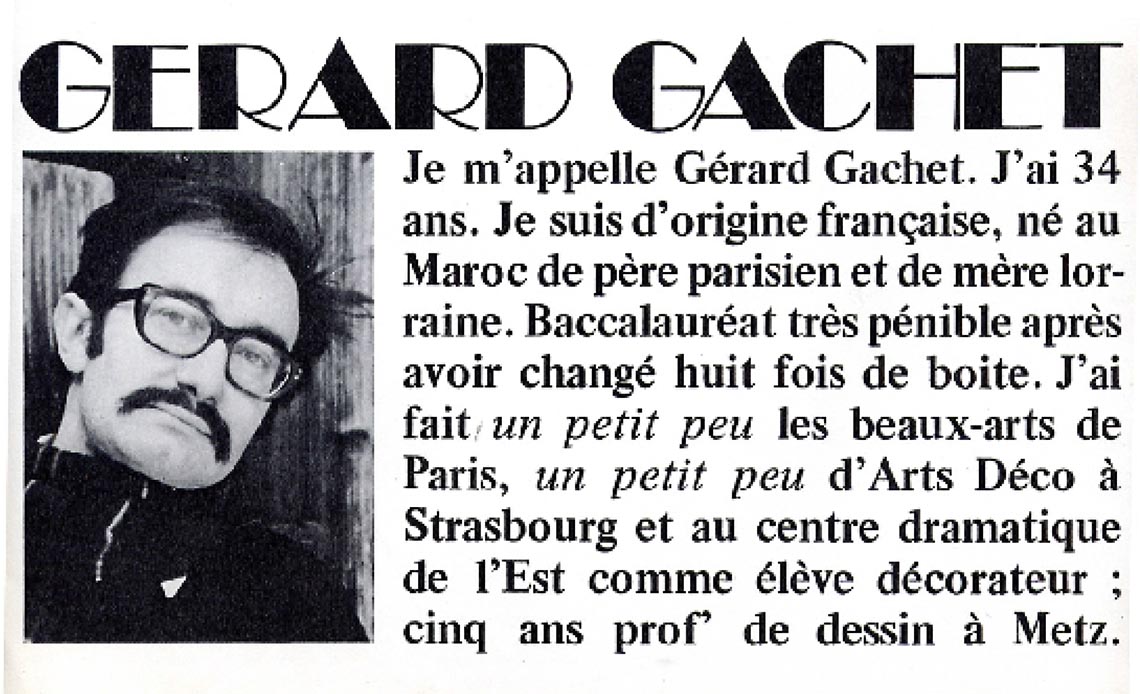
ZOOM: How do you situate yourself graphically?
GACHET: Let’s say fantastic realism to simplify things. In any case, that’s what affects me the most, personally.
ZOOM: Why drawing and not painting?
GACHET: I don’t have a painter temperament. I work mainly in the field of composition, or possibly material effects, but I have little taste for color, I feel much more comfortable in drawing.
ZOOM: Where did you publish?
GACHET: Especially in the Anthologies Planète and then in some magazines on the right and left, I do illustrations for regional magazines from time to time.
ZOOM: You have also exposed.
GACHET: A dozen exhibitions in Strasbourg and two in Germany. I have been living in Strasbourg for 12 or 13 years and I have exhibited almost every year at least once. I lived in Paris for a while and settled in Strasbourg. Before, I was a little, how would I say, homeless and then I settled down. Well, I think life is very nice when you get acclimatized to it but there is the problem of dialect. Alsace is a bit like French Switzerland.
ZOOM: So why did you choose Strasbourg?
GACHET: Hard to say. I know almost all the cities in France and I must say that Strasbourg is very pretty. Of course, at first you have to make a little effort to integrate, I learned Alsatian and I think that now it is starting to come.
ZOOM: Is there a relationship between your production and the “climate”?
GACHET: I think what I’m doing is quite similar to the fantastic and the German romanticism. It’s pretty close to the Vienna school and things like that. I’m thinking of Fuchs, for example. I am very sensitized by this German romanticism, this expressionism, this morbid sensitivity, this kind of writing, it is difficult to define in a few words, this German romanticism which is of all times and which we find besides quite as well in the minds of the people as in their way of feeling the art which is quite particular and obvious. There is everything that is forest, etc. For example, I claim to be an excellent fisherman, and the research side of nature is quite German. I’m not a city dweller. Even in Paris, I know I’d be completely drowned. While I feel quite comfortable in this form of countryside, the fir trees, the Rhine, etc… and all these legends, which I must say, speak to the mind and emotion.

ZOOM: And for the work itself, you don’t have any problems?
GACHET: Yes, of course, he’s only a good artist from Paris. That’s the way to get the national rating. I put myself on the sidelines, voluntarily.
ZOOM: Usually painters, draftsmen, let’s call them artists if you like, make a name for themselves in Paris and then go abroad to work quietly.
GACHET; I believe that before making a name for yourself in Paris, you must first possess technique and ideas, at first, and then arrive in Paris with at least something to show. I try to be as humble as possible but it’s sometimes difficult, but finally, we’re still quite far from the mark. Moreover, we never know where we are going, these searches are done a bit on paper; we progress in an insensitive way. I’m still going to try to get to Paris. I’ve made some contacts. I stopped by the gallery to see Three plus Three. They seemed interested in what I’m doing. They would like me to present them with originals. These are milestones in the fairly long term. I sold pretty well at the last exhibition I did between November and December in Strasbourg and I don’t have much to show anymore. I’d have to get back to work.
ZOOM: You still wanted to show your drawings at first, to make them known?
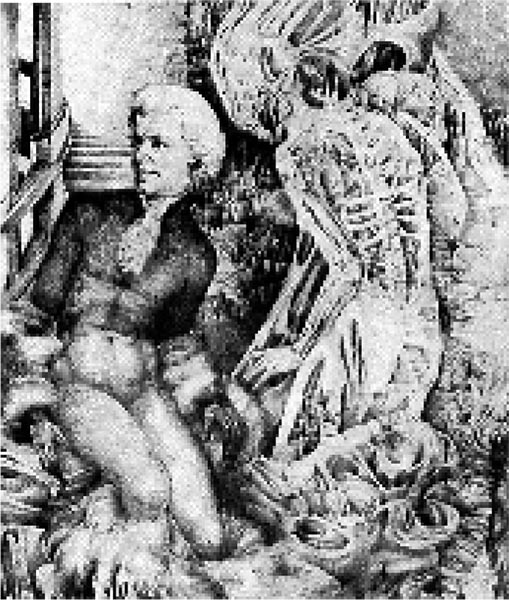
GACHET: The first thing I did, I went to Planète, I met Chapelot quite by chance. Between two doors. I showed him pictures of what I was doing and he told me that in the first issue of Planet I would have an illustration. I didn’t believe much in them at the time and I’ve been working for them for three years now!
ZOOM: What jobs do you accept and what jobs do you refuse?
GACHET: First of all, they have to be illustrations for a fantastic text. What matters is that I try to maintain my style and at the same time give the public and my clients what they expect.
ZOOM: Do you have a particular working technique?
GACHET: I worked a lot on the ballpoint pen and then I had problems because the pen tended to fade, to pass to the light, then I managed to fix it with a varnish and now it seems to hold pretty well.
ZOOM: Do you still work with a ballpoint pen?
GACHET: I find this technique more interesting than the pen. This allows me to have fades, surfaces, values, that the pen until now did not allow me to do. I think it’s a bit dry and a bit milky. This does not allow for surface gradients, which I can get with a ballpoint pen.

ZOOM: What about the composition?
GACHET: It’s very composed in general, very prepared. I have an abstract idea or symbol. Right now, for example, I’m quite sensitive to the psychology of expression, and symbols and things like that. For example, I’m starting from a symbol, a completely abstract idea.
ZOOM: There is a certain erotic concern in your work that is not particularly abstract.
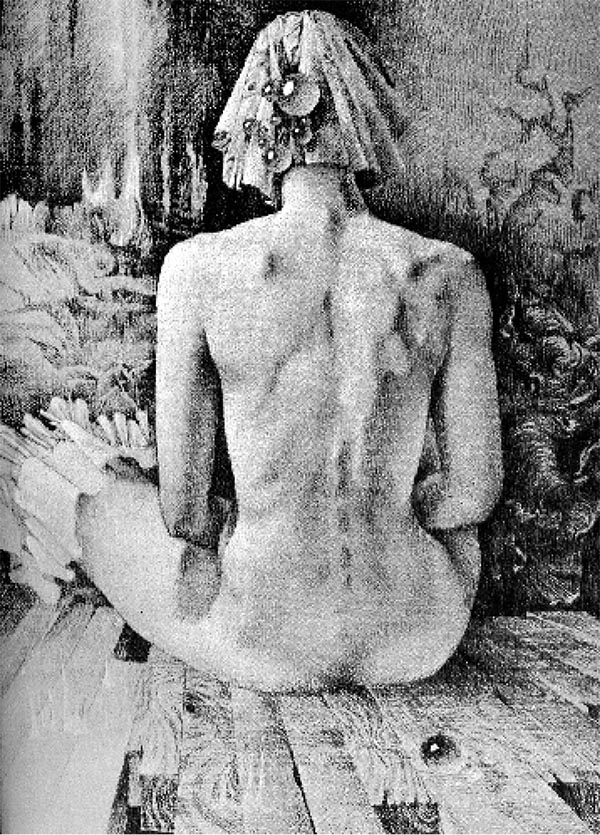
GACHET: I think it’s a period. I’m thirty-five. There are two forms of eroticism. There is the eroticism of the eighteen-year-old boy that lasts until about twenty-eight/twenty-five years, which is a somewhat systematic eroticism and then, finally, the real eroticism. That’s the difference between the gourmet and the gourmet. It is better to be a little seated in existence to really perceive the eroticism. It’s a very intellectual thing. You have to be a little fetishistic. It has to go through a kind of abstraction, no, it may not be the word, through a kind of synthesis of desire to transform it back into a symbol. I don’t do free eroticism. I think it’s a way for me to come to mean myself in the drawing and to engage in correspondence or conversation with the readers or those who look at my drawings.
ZOOM: What are the criticisms that have been leveled at you, in general?
GACHET: Quite often I have been criticized for being a little too literary. Or romantic. I readily admit that I tend to load my drawings with symbols. I take great care of the composition, it is really a composition to the rule and compass. Once the composition is solid, I let myself go and free myself, but first I want to be sure of the desired balance or imbalance that will have to translate in an abstract way the spirit of the drawing. I then add clearer and more obvious intentions.
ZOOM: What do you think of Bertrand?
GACHET: I think that technically it’s very strong, it’s obvious. In fact, in the first issue of Zoom he presented himself as an anti-intellectual, which I don’t believe, in fact. I would like to believe that he is defending himself against it, but I believe above all that in the choice of his subjects, in the way he illustrates his fantasies, he is very intellectual. But there are things that are possible in painting, such as the visual impact offered by color, that do not exist in the drawing where one is forced to cheat. But when I say that a drawing can have an intellectual basis, it must not become cumbersome and demonstrative. On the contrary, my drawings I imagine them as Spanish inns, everyone brings what he wants and they are starting points. There are a number of contingencies that are proposed but within a range that is intended. To go back to Bertrand. I think we’re both caught up in a trend that’s called fantasy realism or the new reality; things like that. But Bertrand is exclusively interested in women. It is a choice that seems determined to me. And I’m afraid it might be a little limited. I didn’t see enough of him, I only saw women and my faith, they are very well drawn. This boy has a crazy talent and what worries me is that he’s a young boy and he’s locked in a system. Perhaps I wish he would vary his sources of inspiration to truly give his maximum. I’m not saying I’m not interested in women, graphically, but it’s not exclusive. I don’t see why I wouldn’t mention this possibility of expression, but I don’t want to be cataloged as an erotic artist either. I would be very remiss if I fell into that category.
ZOMM: And the fantastic, what does it mean to you?
GACHET: The fantastic is something that bothers and appears to be relatively dangerous. For example, I love Max Ernst when he mixes up to be really fantastic and not surreal as he sometimes is. Leonor Fini especially what she was doing a few years ago. Today I don’t like its slightly crumpled colors which seem to me to be more demonstrative than really felt. Maybe she’s trying to renew herself, but I think it’s in fantastic realism, in this painting, that the climate is strongest.
ZOOM: Can you name other names?
GACHET: Beardsley of course, noodle style is the archetype of fantasy art, in my opinion, because it has the graphics and the spirit. However, there are people I do not consider fantastic at all. I am thinking of Bosch, for example, who is a hard-working Adamist. In my opinion, he merely transcribed the Adamist doctrine, which does not seem to me to be entirely fantastic, with a somewhat classified and systematic symbolism. There’s the fantastic deep and then the fantastic second degree hazard.
ZOOM: What is the fantastic hazard?
GACHET: I think for example of some alchemical drawings that are, I would say, fantastic only to the extent that we understand them. We think there is something, we suspect it, we think we guess and when we do not know the message, it is fantastic. Finally, it is a form of fantastic that is not quite satisfactory
ZOOM: We were talking about your symbols and your anxieties earlier.
GACHET: Not my anxieties, my fantasies, it’s prettier. And then my symbols are easy to decode, especially in the field of illustration.
ZOOM: Is illustration your favorite activity?
GACHET: The dream would be to make only illustrations of fantastic texts. Texts by Mandiargues for example.
ZOOM: Do you have self-criticism to make about your drawings?
GACHET: For now, I’m stuck. And then you have to change the technique, vary. Whenever I feel that I am going to be blocked by a technique, I try to use another material, another medium, which forces me to think differently. I think it’s quite obvious that the technique is the basis of the invention. I say invention because I deny the artist the right to create, just the right to invent, I believe that the word creation is reserved for the Gods who use it quite well. As for the technique, I prefer drawing because it is a problem of speed, although I take about a week to make a drawing, but I have the impression that if I paint, I am forced to impose myself to a ceremony, a gymnastics, finally something that bothers me a little, it is necessary to wash the brushes, it is necessary to make a number of gestures which, I have the impression, disperse me. When I draw I am truly seated with myself.
ZOOM: You seem a little obsessed with technical questions. Other designers are rather worried about their possibility of renewal of inspiration. This question doesn’t seem to affect you.
GACHET: I never really asked myself this question. For me, there is always or never a problem. Inspiration is something that cannot be invented. We either have it or we don’t.
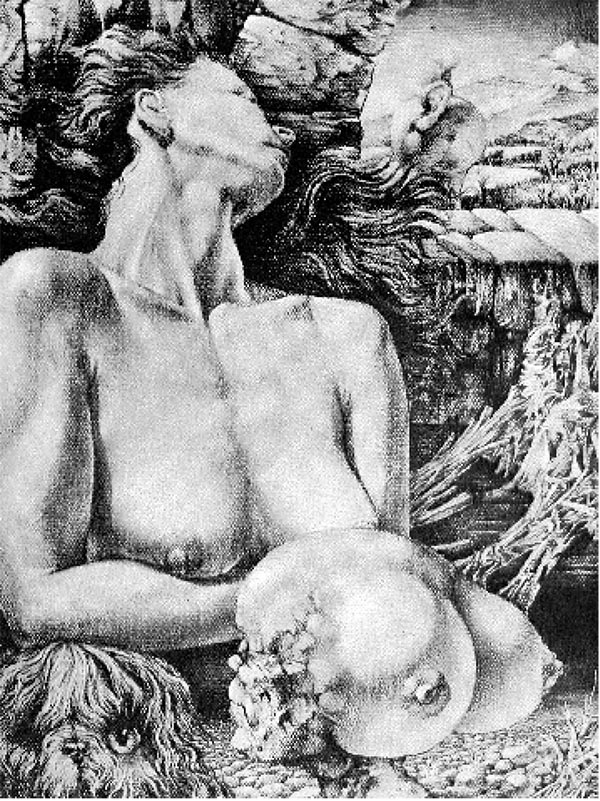
ZOOM: It seems that some people are concerned for you about your inspiration and in a very particular way. I’m talking about the incidents at your last exhibition.
GACHET: It wasn’t my exhibition. There were Bertrand, Rimbault, Roldan, Maury and me (they are people from the gallery Three plus Three). There was an act of vandalism. I had four lacerated drawings, Bertrand had one and Rimbault had one too. It was between Christmas and New Year’s. During the night, we broke into the gallery. The drawings were taken out of the coasters and torn with a screwdriver. Why? We don’t know. II may be the Puritans who could have been concerned by this exhibition but they had every opportunity to use legal and moral means to justify their discontent, but there was nothing official, no petition, no scandal of this kind. Or I could be targeted personally, maybe the gallery, maybe the gallery director. The director filed a complaint and so did I. The case is ongoing, and I don’t know what’s going on. It’s still quite surprising.
ZOOM: Don’t you know any enemies?
GACHET: No. There’s this sentence marked on the cover of an anthology Planet: I prefer the bad guys to the fools, at least they rest. When you don’t precisely associate with the bad guys, you don’t suspect that there are fools who can replace them on the spot.
ZOOM: You said before the interview that in this exhibition nothing should have shocked since it was all about taking everything, a good-toned eroticism. What do you mean by good-natured eroticism?
GACHET: Let’s say it was an allusive eroticism more than a medical or anatomical demonstration. You know, eroticism is the porn of others. It’s a well-known phrase, we can turn it around.
ZOOM: I think you have another passion than drawing, your passion for reptiles.
GACHET: Yes, yes. In my house there are seven reptiles, an aquarium, a monkey, a dog and my wife of course. Among the animals it is the reptiles that I prefer by far.
ZOOM: Why?
GACHET: These are animals with which we can not do anthropomorphism and it is a great chance that we can dispense with this unpleasant pretext of transfer, projection, on a so-called domestic animal and that we charge with all our small problems and which in fact serves only as an outlet for our dissatisfaction. With my reptiles, you can’t cheat and then they are absolutely beautiful animals. I have a great tenderness for reptiles.
ZOOM: You think they’re giving it back to you?
GACHET: Sometimes, but I don’t expect them to give it back to me. They are absolutely autonomous animals that do not need me and that is very important. I try to live in good company with them. If they bite me, it’s all my fault. It is a possibility to be in front of nature, not as we want it but as it exists with its imperatives and its laws. Reptile attendance should be considered one of the fine arts. I have a small snake with a necklace, I have an Indian snake, a python, a Montpellier snake, a viper, a cobra, a tailed whip.
ZOOM: It still gives you time to prepare an exhibition for Paris.
GACHET: Yes, but I don’t want to exhibit in any gallery. I think it’s horrible to exhibit in a fifteenth-order gallery in Paris that nobody cares about and that lives miserably by the money that painters leave there. It’s a real scam. I don’t care about exhibiting in Paris. It’s not a problem. I won’t feel grown up for having exhibited in Paris. I know boys, because they’ve been in a shabby gallery in New York City doing leg circles. There is a nuance between work and career.
I am thinking of some of the painters who have arrived and who do not deserve the praise they receive at all. I think of Buffet and people like that who seem to me to be pranksters unworthy of having entered the second year of the Decorative Arts. These are people who are victims of graphic finds that they use absolutely in every way. These are people who are making a career; of course, they have Rolls-Royces. Good for them. I don’t think that’s enough, although I’m not spitting on their Rolls-Royce.
ZOOM: Isn’t there some jealousy in your judgment?
GACHET: No, I hope not, I don’t think so. They must be unhappy if they are honest with themselves. There are apparently hundreds of Buffets in gallery cellars in Paris that can not be put on the market because it would bring down the coast. I think it’s really the joke, the farce, this miserable side of Paris that claims to survive for ten years, that no longer exists and that still attracts the gogos. There are no more Americans in Paris who come to buy the paintings as in the past, there are no more American pigeons, so obviously it is much less easy. This notion of rating is a problem of supply and demand first. Once the public understands that, then it will be perfect and we can say that the painter who sells is the best and the one who does not sell the bad, at least the least good. In any case, our time is not what it used to be. The cursed painter, that no longer exists, I mean those who have talent and who do not succeed, there are enough talent-scouts on the right and left to look for hidden talents. I no longer believe in cursed painters, it is an implausible thing, there are enough opportunities for everyone.
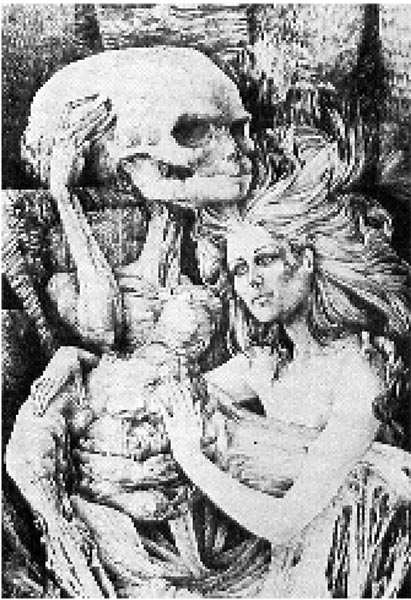
ZOOM: When you have finished a drawing, are you satisfied with what you have just done?
GACHET: I am satisfied when I am doing it, I feel self-hypnotic, I am relentless on this drawing, I do not stop until I have finished it, but then it no longer belongs to me. It’s a thing that came out of me, a moment, past and I think of the next, I look at it with a certain tenderness, for example for a week and then I could sell it to the last of the butchers in the area. I think it’s a fairly significant problem because very often painters have a kind of tenderness for their works, whereas on the contrary you have to know how to get rid of them quickly. It must come out of the mind, it is something that must no longer exist in our thinking, something resolute, a moment that we have put on paper. It’s like a child, you have to have the courage to let him live his life.